Category: The Way of Saint Thorlak

  • The Cross of Autism

    The Cross of Autism

    This article was first posted with the Mission of Saint Thorlak in April, 2019.

    by Aimée O’Connell

    When Good Friday gives us pause to consider Jesus’ Passion and Crucifixion, our attention is most naturally focused on suffering, even to the extent where the words “cross” and “suffering” have become intertwined in the Christian lexicon.  For much of my life, I have equated “the cross of autism” with enduring the suffering particular to this condition and accepting it as my lot.  Perpetual anxiety, painful sensitivities to light and sound, headache and nausea in noise and crowds, inability to express emotions, difficulty speaking… all of these have been realities for me, along with debilitating exhaustion and a heavy measure of self-loathing when I fall short in acting up to social expectations.  All of this seemed in line with how I took Jesus’ Passion and Crucifixion to be.  In my spiritual immaturity, I saw Jesus’ suffering as a demonstration of “walk it off.” Take what life deals us, even when it’s unfair, and carry on without complaining.

    Perfection in suffering, to me, seemed that I should do it so that nobody knew I was suffering at all.  I reinforced this idea with Mother Teresa’s admonishment to “do everything with a smile,” and with Matthew 6:17, which exhorts us to fast and sacrifice without making a show of ourselves.  I also tried to rationalize this through St. Therese’s Little Way, proposing that “doing things with great love” meant doing them so as not to bother the people around me with my problems.

    Through the grace of God, and the fruits of my time spent in prayer this Lent, I am learning to see now that this is not at all correct.  It is an overly literal distortion of what is actually meant by each of those spiritual maxims.  My view has been rooted in manipulation – that is to say, manipulating my suffering to such a degree that I denied it, and I denied myself the chance to experience it fully.  In denying the truth of what I suffered, I paid the triple price of ordinary exhaustion plus the extra work of maintaining an untruth plus enslaving myself to standards I cannot possibly reach or maintain (and in the process, unfairly raising the expectations of others).

    I see now that Jesus never “walked it off.”  He knowingly faced his accusers with complete vulnerability.  He told the truth of who he was, knowing it would be rejected, mocked, ridiculed and punished.  He made no pretense that the scourging was mortally painful.  He did not suggest he had the strength to carry the cross.  He did not say he would not die if he was crucified.  He knew every one of his limitations, and he offered them to the extent he could.

    The actual cross of autism is embracing what I can and cannot do, in the same plain nakedness as Jesus.  To do this, as St. Therese implores, “with love,” it is not to pretend it is fun or easy.  Rather, it is to accept and believe that I am loved as I do.  Even in my weakness and shortfall, God loves me fully… right here, right now.

    And, guess what?  This new way is harder.  Walking it off is nothing compared to checking my pride and admitting that I can’t do something, especially when it’s someone I don’t want to disappoint, like a friend or a superior or a family member.  Admitting the truth would actually spare me the pain of sensory overload and trying to do what I don’t have the energy or adequate capability to do, but it requires stripping myself of the clothing of my pride.  In that moment of truth, it is so tempting to heed the voice of the thief tempting me to avoid the cross and save myself from revealing my vulnerability. But, as we saw with the two thieves beside Jesus, one embraced his need and brought God present; the other sneered, preventing God’s grace from saving him.  Even on Calvary, where two or more acknowledge their need before God, there He is with them (Matthew 18:20).

    The ordinary suffering of autism remains the same.  The anxiety, the exhaustion and the sensory overload are part and parcel of our condition. But in the absence of acknowledging this truth about ourselves, the suffering becomes dead weight… a thankless burden we adopt in exchange for the chance to look strong, to avoid being naked in our need, to not be mocked, criticized, or accused of being lazy. Yet, we know what’s true.  Are we willing to stand up for that truth, as Jesus did?  We begin by accepting God’s immediate, unconditional love in these weakest, most naked moments of truth… and discovering, to our surprise, that God’s love alone is real and plentiful enough to withstand the insults of those who refuse to believe, and to sustain us through all of our needs – good measure, and flowing over.

    May each of us experience the reality of this love, abundantly, as we meditate upon the mystery of the Cross.
     

  • Prayer: Let Me Be Leaven

    Prayer: Let Me Be Leaven

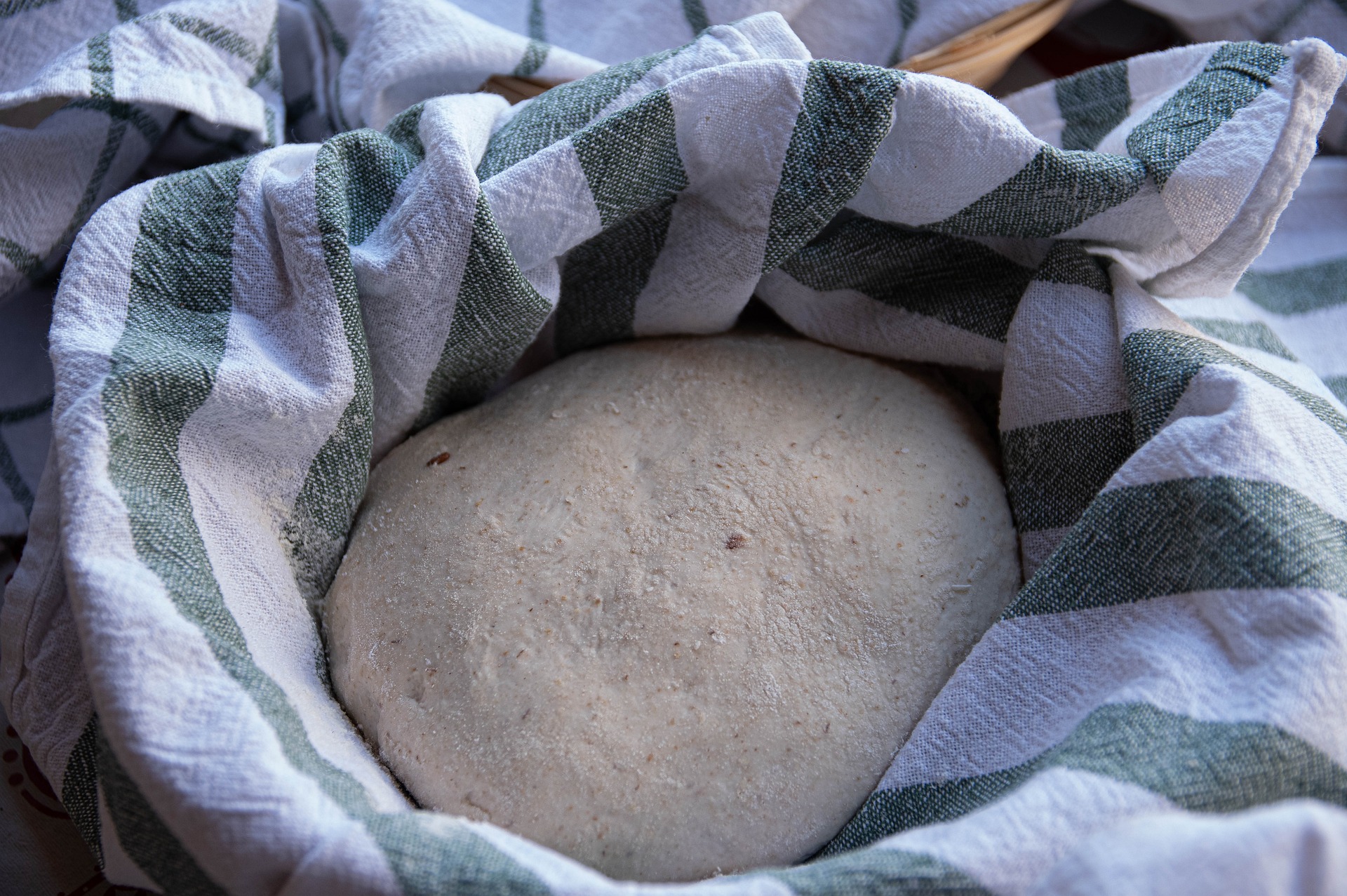
    A new addition has been made available on our Prayer page, entitled “Let Me Be Leaven,” based on the very brief parable in Matthew 13:33 –

    “The kingdom of heaven is like leaven which a woman took and hid in three measures of flour,

    till it was all leavened.”

    There are many, many times when we find ourselves in situations where we ask whether or not we should stay, or whether we would be missed if we leave.  Oftentimes this has something to do with our neurodivergence – our being misunderstood, or not noticed, or not able to participate because our needs exceed the accommodations available.  It is an awful feeling, to say the least.  There are times when it is obvious that it is appropriate (maybe even necessary) to leave.  Other times are more ambiguous.  We may want to stay for many valid reasons, but question whether it’s worth the cost.  We may feel a sense of loyalty and belonging, even if that is not always reciprocated.  It may be important to follow through on principle.  Or, we may very simply want to be there because we are there – which is valid reason enough!

    For those times, the parable of the leaven in the Kingdom of God seems an apt comparison.  Aside from any physical parallels between how we feel and what dough endures (need we mention kneading, punching or pulling?), the idea of leaven makes an interesting meditation.  Our Lord spoke of leaven to describe how something small and humble grows into something grand and nourishing to great numbers, referring to how the Kingdom of God grows with each simple “yes.”  And yet, the process of leavening is also worth pondering, if we consider how yeast works alongside and within the popular and easily recognizable pantry staples.  Indeed, the sometimes silent, sometimes turbulent action of yeast is absolutely essential to the growth, expansion and full expression of the finished product.

    Here is the text of the prayer.


    Lord, let me be leaven.

    When I am unseen, unheard, unknown in my community: Let me be leaven.

    Let the full spectrum of me be present, if undetected, exactly as I am: stimming or still, restless or recollected, vocal or silent, vibrant or subdued, needy or fulfilled.

    Hide me deep within surrounding measures of activities and committees and busyness and social gatherings.  May my presence permeate and thrive within the community, even when it is not perceptible.

    Take into Your Loving Hands my yearning to belong, my desire to serve, the gifts I would share if given the opportunity – and rest them safely beneath the warmth of Your gaze, to rise and expand and thrive in the time You appoint.

    Lord, hide me in the places You need me to be, and let me be leaven, wherever You lead me.


    Amen.


  • PDA and Lent

    PDA and Lent

    Here is a very interesting question: How can we troubleshoot between having a PDA profile and the necessary demands presented by Lent?


    There are a few guiding thoughts to help tailor Lent to the demand-anxious neurotype while keeping the intention and integrity of the season.


    Creativity: Try to plan for Lent as a response to a design challenge.  The Church outlines three staple ingredients: Prayer, fasting and almsgiving.  What we do with them, how we bring these to life and in what way, is up to us.


    Autonomy: For the most part, we get to decide what we do and how we do it.  The boundaries provided by the Church pertain to Ash Wednesday and Good Friday (where we are asked to begin and end the season with meatless fasting), and Fridays during Lent (where we are asked to abstain from meat).  We might think of these as signposts and checkpoints employing the method Our Lord used in preparing for His public ministry to mark off this time as our own period of sacred preparation.  We might also think of how we find ordinary places closed to commemorate certain occasions every year, and, likewise, our regular meal habits are “closed” on Ash Wednesday and Good Friday, and “partially closed” on regular Fridays during Lent, in commemoration of Our Lord’s sacrifices.


    Low-Key: As with everything else, our Lenten practices will be more successful and meaningful if we strive to keep them nonchalant, low-impact and not all that drastic.  Aim for small steps rather than big ambitions.


    Short-Term: Yes, Lent is 40 active days (and 46 days all together).  We can still make our plans day by day.  With demand anxiety and time blindness, sustaining anything more than a few days at a time runs the risk of not going well.


    Rephrase: Words like “discipline” and “obligation” can be our downfall.  When we come up against these terms, why not turn to a thesaurus, or an etymology reference?  When we realize that “discipline” means “learning” and “obligation” gets its roots from the concept of giving thanks, the sense of demand is lessened.


    Flexible terms: Be prepared for multiple contingencies.  Similarly, keep a wide field around the bull’s eye, so that coming close is an acceptable alternative to perfection.

    Novelty: Related to creativity, this is a reminder to keep things interesting so that we feel motivated to continue.  Lent does not have to be monotonous.  Change it up often enough to keep going.


    Menu approach: Sometimes, there are too many choices.  Sometimes, there is not enough structure.  Yet, too much structure feels confining and restrictive.  One way around this is to make a Lent menu to consult day by day, whereby we strive to balance our practices between variety and predictability.  A menu also allows us to put a check mark next to the things we’ve done so that we can see our progress and where our strengths are.


    Spark love: Similar to that other phrase used in a popular and patented home management program, try to keep those things in our routine which “spark love” in our hearts for God, and move on from those things which do not.  Love is a good choice here because it can be both joyful and sacrificial.  When we strive to do things for the sake of love, chances are, these will be things we will find worth doing.


    Equivalent substitutions: Many Lenten practices can become prickly, such as dietary changes or trying to give things up which help regulate our functioning.  Being hungry is one thing; being hangry is another.  We are sometimes not able to fast the way others can, and this is where creativity comes to the rescue again.  The idea is not to circumvent what’s difficult, but rather, to decide prudently what is and is not possible.  When we simply cannot fast, we can calculate the equivalent and make an offering with what we can – such as, matching (or exceeding) what we eat that day in a donation to a food pantry, or donating money/time-per-calorie to assist a cause in our area – either in person, or through prayer, remotely.


    Pilgrimage: We can’t always make a retreat, keep up with Bible studies or attend prayer services.  We can, however, design our own spiritual pilgrimage in the form of any kind of sequential progression during the Lenten season.  We can move forward on this at our own pace, some days a little and some days a little more, and some days not at all.


    Growth mindset: Instead of looking at what we do as pass/fail, growth mindset accepts that we do not yet have all the skills to be successful all of the time, but believe we can gradually move in the direction we want to go.  Essential to this is resolving not to compare ourselves to others or set our progress by others’ standards.  Curiosity, openness, humility and freedom from pressure are our tickets to growing in our spiritual lives as much as in any other area.


    May God bless our efforts and reveal His love to us, in all that we do this Lent!