Author: Autism Consecrated

  • ACAT 6: Happy with God in the Next World

    ACAT 6: Happy with God in the Next World

    The Baltimore Catechism has told us that God exists, is the creator of all life, and desires to have us here to know him, love him and serve him… and then, to be happy with him forever in the next.

    If we notice, our catechism takes quite a jump from “why are we here?” to “where do we go from here?” in that last clause of the sentence.  We go from knowing God, deciding we love him and choosing to follow his designs to then reaching bodily death, at which time the terms become: <we will be happy> / <with God> / <forever> / <in the next world>.

    1) We will be happy

    Keeping in mind the Baltimore Catechism was written with school-aged children in mind, this word “happy” should be taken at face value.  We can interpret this in the most simple way, a shortcut for the sum total of things that include contentment, peace, delight, freedom from anxiety and, generally, anything we’d tag with a smile emoji… only, on a much deeper, more fulfilling level than the things that we’re used to, that last only until they fade or the next good thing comes along.  This is an enduring happiness, a perpetual contentment, a rest of the soul that once was restless.

    2) + with God

    Does our bodily death free us from the spiritual signal-blocker that keeps us from seeing God face to face?  Does bodily death transport the soul from here where God is not, to there, where God is?  These things cannot be satisfactorily defined or studied, and so, the particulars of what physically constitutes the afterlife remains up for both scientific and theological discussion.   It is, however, a term of our faith that we believe, in some capacity, that our soul remains alive and is able to perceive God with the certainty and clarity which our bodily existence cannot permit.  We concede the “what,” knowing we do not have a definitive way to describe the “how.”

    3) + forever

    As theologians understand the reality of God’s creation, there is both linear, measured time here on earth and a transcendental, non-measurable state of “just being” that is so vast and deep as to defy linear tracking.  That word “forever” can evoke anxiety when it is something of an unknown quality.  Even though the terms already include being “happy,” there is a permanence to this “forever” that triggers a second-guessing in our human nature.  We are conditioned to know where our exits are, how the escape hatch works, and how to tolerate being stuck by anticipating that things will eventually change.  The key here is to remember that God’s “forever” is not static.  God’s reality is one of constant creation, perpetual beginning, perfect stability and all-encompassing security.   This “forever” is more like the state we find ourselves in when we finally hit our stride and want to keep going.

    4) + in the next world

    Ah, the afterlife.  So many connotations, so many explanations, so many words.  The term “heaven,” for instance, originated in the ancient belief that souls travel beyond the bonds of earth’s atmosphere, into the firmament, to join ranks with the stars.  We have modernized this concept to also mean “perfect bliss” or “supreme pleasure.”  But “heaven” is not the only way to refer to the afterlife.  Our catechetical writers refer to “the next world.”  What does this mean?  In the purest sense, “world” means a specified environment containing the sum total of interactions and experiences therein.  “The next world” can mean both the place itself and the way we experience it, just as in gaming there are many successive worlds in which the same player can interact in different and increasingly sophisticated ways.  The takeaway here is that, once our soul is separated from our body, our experiences and interactions do not cease; rather, they continue, in a manner which we can only access once we graduate to that level.

    And so, there it is.  God created us, and offers us to live and use our life in this world to discover him, and consider offering our love and support of him in response.  Those of us who do will experience him here and then receive the happiness he offers us with him in the world to come.

    We conclude with a brief parable attempting to explain the principle like so:

    If this world is a forest, and we are each a tree, the forest is that which nurtures tree growth, and no tree diminishes another’s importance.  God imagines us, tree after tree, with great love, and places us in this forest to be both delightful as ourselves and to be delightful to the other trees.  Once we have grown to fullness, we can see what we, and each other tree is to become.  The trees who embrace being trees of the forest will thrive in the fulfillment of their design.  The trees who doubt can choose not to remain, but by this choice, they may still become something useful – but they can no longer fulfill what their creator imagined they would one day be.

  • ACAT 5: Serving God

    “Knowing, loving and serving God in this life” are the first three reasons given for God creating us in the first place.   As much as we have systematically looked at these as an interconnected process, there still remains the fact that most of us take all of these in one bite.  We are here to know, love and serve God.  That word “serve” puts quite a spin on the first two, doesn’t it?  Let us imagine, in utter absurdity, inviting a total stranger to a lavish dinner.  Afterwards, we approach our guest with this greeting: “Hello!  Did you like your food?  Was everything to your satisfaction?  Wonderful!  I invited you here so that you could get to know me.  I actually kind of hope you’ll come to like me… maybe even one day love me.  And then, you get to serve me!  What do you think?”  As their laughter dies down, our guest would most likely leave – well fed, but never to return.

    We do well to ask, “Are they serious?” in reference to the writers of the Baltimore Catechism.  It’s a pretty bold move to lead off with something that strong.  At least give us a little more before revealing the catch, right?

    Well, as we saw last week, “serve” does not necessarily mean “submit to” or “do labor for.”  As we come to know someone, and grow fond of that someone, we tend to extend ourselves for that someone in ways that overlook convenience.  It may objectively be a chore to do a favor for someone, but when it’s someone we love, and when it’s a desire of our hearts, it’s not perceived as a chore.  The reason is, we freely choose to say “yes” when it’s someone we love.  Sometimes we even offer before they ask.  On the flip side, if our someone was to demand, coerce or accuse in the course of seeking our favor, we might not be so eager.  We might refuse, or, if we do the task, harbor a certain measure of resentment.

    Free will is key to understanding service.  Also, a good dictionary; even a thesaurus!

    The Word Web app gives these suggestions for “serve:”

    • Act to fulfill a purpose
    • Do duty or hold office
    • Perform a specific function or role
    • Contribute
    • Be used by
    • Give a portion to
    • Provide
    • Promote
    • Benefit

    We could substitute any of these, easily, and see how they fit with our willingness to approach God.  If he created us to know him, love him and “act to fulfill a purpose for him,” that almost seems amazing – that God would have some purpose in mind for us just because we were born.  To “do duty for God”  seems like we’ve been chosen, found worthy, passed muster.  To “benefit God” is perhaps the best one of all.  Could my life really benefit the Creator of the Universe?

    Of course, in there too is “be used by,” and “promote,” and “give a portion to.” Yet, again, we would have to objectively see if these things are demanded of us or hoped for from us.  When people say that “our God is a God of hope,” it is both that God is a source of our hope AND that God hopes we will say “yes.”  God does not force anything.

    Some will still say that this is merely an optimist’s view of religion, and that ultimately it still comes down to control.  We invite a review of the evidence to see if that bears out, and we will concede any point that definitively proves God forces anything.  Since time began people have debated the existence of rules, terms and conditions, since it seems there are certain non-negotiables when it comes to God and Church.  This is more or less where “promote” comes in.  God did not create us as billboards, necessarily, but more as creatures particularly well able to reflect his goodness and mercy.  We can promote the beauty and clarity and integrity of God’s order by demonstrating it in action, or we can take liberty with our own interpretations… with the caution that the former rests on trust, and the latter, distrust.

    Ultimately, it comes down to a simple choice: “Yes, I trust that God’s intentions are pure, beautiful and have my best interests in mind” or “No, I don’t trust God, because I think he his ulterior motive is to gain control over me.”. One is surrender, which calls for our willingness to risk our vulnerability; one is submission, which accuses God of demanding our freedom from us.

    Before we make our choice, consider how each of these attitudes affects our ordinary relationships.  How well do we thrive on receiving the trust of others, and how difficult is it to endure the perpetual badgering of the distrustful?  One promotes order; the other, disorder.

    There’s that word again, promote.

    Feel free to choose whichever synonym communicates “relationship” best when reading that pivotal sentence, and take it to heart as we ponder our purpose: to know, love and serve God in this life… and then, to be happy with him in the next.

  • ACAT 4: The Process of Relating to God

    ACAT 4: The Process of Relating to God

    [Readers, please note: Ordinarily, the respect due to God is expressed by capitalizing the H in pronouns.  However, writing about familiarity in relationship requires a lot of these pronouns – and that capital H is becoming distracting.  God deserves respect, yes; but he does not demand it to the point of distraction.  We considered what it would mean to drop the capitalization in favor of increasing comfort and familiarity, and it feels right.  We mean no disrespect to God by using lowercase pronouns.  We offer it to God, in love, as a sign of our desire to grow closer in familiarity with him, intending no offense.]

    Last week, we began looking at the Baltimore Catechism’s proposal that God created us to know him, love him, serve him and be happy with him in the life to come.

    We suggested seeing this first as a task list given in order of importance, with each step intended to prepare us for the next, flowing with a natural logic.  We can’t love someone without knowing them.  We can’t serve someone without loving them (and, before any buzz starts, we already have Missionary Thoughts lined up to go more deeply into that word “serve,” especially wondering how it can lead to happiness when it sounds so contractual).

    Yes, each step is a foundational block, and each successive step builds further on the previous one.

    But it is not a flat, linear progression.  It is a dynamic process, a progression of modules leading one to the next and then building upward, constantly adding more layers for each completion of the cycle, day after day in our lifetime.  The four together are a constant, living process.


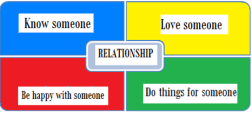
    This process, in fact, describes building a relationship with anyone:


    When an enduring relationship is forming, what we discover about someone (= getting to know them) eventually gives rise to a particular fondness.  We can feel this as we feel love toward our family members, or toward our friends, or in the general sense of the value and dignity we feel toward others.  But then, we begin to concretely “love” in the verb sense by showing affection, or speaking affirming words, or including people in our activities as we might invite a friend, a guest or someone on the sidelines without a partner to participate in what we are doing.  We love by giving gifts, making food and welcoming visitors.  Loving can be offering to drive somewhere, or answering the phone when we are already tired, or forgiving those who overstep their boundaries with us.  If we notice, knowing (taking in concrete, measurable data) gives way to loving (forming an abstract conclusion) which gives way to doing, or serving (concrete action motivated by abstract feeling).

    Thus, loving forms the bridge between knowing and doing (or, serving), which leads to being happy with each other in the relationship.  As each module augments the other in the process, a foundation is formed.  The process repeats and repeats and repeats in the rhythm of the relationship, as though placing bricks one atop the other in an ever-growing structure.


    So, how easily can we replicate this process when our someone (God) is not three-dimensional?

    Knowing: Books, videos, homilies and Scripture are some of the many formal ways we can know God, but evidence and ideation of God occurs frequently and much less formally.  Imagination can be the best tool for us to encounter God interiorly and to make deeply personal and emotionally relevant observations that will help us know him better.

    Loving: Can we yet sit back and reflect on what we are reading, what we are hearing about God, what we see in creation around us, through natural beauty and the love of animals, and feel a connection with – even a fondness for –  God?  Maybe so… or, maybe not yet.  Maybe it comes and goes.  If all we do is believe he is there, eventually, we’ll find him… but only if we pay him attention and remember to include him.  He is just like any one of us who are not easily seen or heard above the others in the room.  Silence does not mean he is not interested and not participating in our lives.

    Serving: Moving from the abstract toward the concrete, how can we enact our love of God by responding to what we know about him?  How are we to know what delights him, what needs he has, or what he might ask as a favor?  We can’t give God rides to the store, or buy him gifts, or make him dinner.  We can’t listen to his hard day’s work stories or let him stay an hour past when we told him we had to go.  However, in Matthew 25:35, Jesus says, “When you do it for the least among you, you do it for ME.”  We can love God by loving his proxy, the person in front of us.  Service becomes a tool to discover and express our love, not a mandate – but more on that next week!

    Being Happy With God:  Relationships take time.  Few of us are ever lovestruck instantaneously, but rather, we cultivate familiarity and comfort by giving our attention to knowing others here and there until they becomes part of our everyday and less an awkward silence in our lives.  The same is true of God.  Loving God means feeling the comfort of his being silent with us the way we welcome our friends to be silent with us… and to let us comfortably be silent with them.